Showing posts with label Samurai. Show all posts

Thursday, 5 November 2015

JNTO FamTrip 2015: Himeji Castle

In late September and early October, Unique Japan Tours joined a familiarization trip organised by the Japan National Tourist Organisation. The purpose of these trips is to introduce new, unique places in Japan to promote trips there. The familiarization trip (or "famtrip") we joined took us from Okayama and Kurashiki, down into Tokushima, to Shodoshima and finally to Himeji.

Of course, we knew most of these places already, and we've sent many of our clients to these places to. But we always want to learn more, look deeper and see what's new and exciting. Today we wrap up our series of blog posts where we're explored the areas we visited, introduced them to you, and shared some of our pictures. Today is part four, where we visit Himeji Castle.

Friday, 21 August 2015

Towns of Japan: Kawayu Onsen

The Kumano Kodo is a religious experience in itself, a multi-day mountain hike (though you can also go by bus), following in the footsteps of royalty, visiting some of the most magnificent temples and shrines on the islands of Japan. Towards the end of the hike, along the Oto River, is a unique onsen town. We love sending people there, to soak in the most unique of onsen. What makes it so special? Read on, to learn more about Kawayu Onsen.

Friday, 24 July 2015

Japanese Pilgrimage Route: The Kumano Kodo

The Kumano Kodo are a series of pilgrimage trails, located in the Kansai region of Japan, south of Kyoto and Nara. Kumano is the name of the area, and “kodo” means the “old ways”, so the name literally translates as the old ways of Kumano. The trails were, and still are, used by pilgrims visiting the Three Grand Shrines of Kumano. The Kumano Kodo, as well as Koya-san and some other surrounding areas, were collectively registered as UNESCO World Heritage sites in July 2004.
Unique Japan Tours Kumano Kodo Mountains Clouds
The stunning beauty of the Kumano Kodo
Source: JNTO

Friday, 17 July 2015

Samurai Postal Routes: The Nakasendo, Tsumago & Magome

In our last blog post we talked about the Gokaido, the five routes built in the Edo period of Japan, which connected the capital of Edo, modern Tokyo, with the outer provinces of the country. We also talked about the Tokaido, one of the two routes connecting the old capital of Kyoto with the new capital of Tokyo. The Tokaido was popular among poets and artists, and was the quickest way between the two cities, but also more dangerous because you needed to cross a number of rivers. What was an Edo period samurai to do, when he was worried about the safety of his family? This is where the Nakasendo comes in.
Unique Japan Tour Tokaido 1825
The Tokaido in 1825
With a distance of approximately 534km, the Nakasendo ran the length of Japan from Kyoto to Tokyo, passing though the modern day prefectures of Saitama, Gunma, Nagano, Gifu and Shiga. The Nakasendo was an inland route, unlike the Tokaido, which followed the coast. Even though the Nakasendo is longer, many travellers preferred travelling the Nakasendo, as it didn’t involve any fording of rivers, thus making it a safer journey.

Wednesday, 15 July 2015

Samurai Postal Routes: Gokaido and Tokaido

In 1601, soon after he came into power, the Shogun Tokugawa Ieyasu started to build five routes connecting the capital of Edo (modern day Tokyo), with the other provinces. These routes were essential for the success of the Sankin-Kotai system, where lords would have to alternate years of living in Edo with their home provinces. There were five routes, including the Koshu Kaido, the Oshu Kaido, the Nikko Kaido, and the most important routes, the Tokaido and Nakasendo, which we’ll explore in more detail.
Even though all the five routes varied in length, they shared some common features. First of all, they all started from Nihonbashi in Edo, after which there were markers at every ri (2.44 miles or 3.93 kilometres) travelled from Nihonbashi. The government ensured the highways were well maintained, and we often flattened and widened as necessary. In steeper sections of the path, the government would pave the road, though they often used ferries to cross rivers rather than build bridges. The government also planted trees along the route to make sure the travellers could travel in the shade, and be protected from the elements.
Unique Japan Tours Nihonbashi Gokaido Stating Point
Gokaido Starting Point in Nihonbashi Tokyo.
Source: Wikimedia Commons

Wednesday, 7 January 2015

Kanazawa: 2015 Holiday Hotspot

     You may have seen Kanazawa was selected by the Guardian newspaper as one of their Holiday Hotspots for 2015. Kanazawa features on several of our tours, both small group and self-guided, and is a favourite destination among everyone here in the UJT offices. Today we're going to dig a little deeper in Kanazawa and discover this beautiful city.

Friday, 19 December 2014

Japan Discovered: The Ultimate Introduction to Japan


     We run a small group tour called Japan Discovered, and it really is a great way to discover what Japan is all about. You will experience everything you could hope to experience on this tour: from the neon lights of the big city, to the serenity of the mountainous countryside, to the peaceful sense of harmony at the temples and shires of this amazing, ancient culture.

Tuesday, 16 December 2014

Reasons to Honeymoon in Japan

      We've talked a lot recently about honeymoons in Japan. We told our story of how we helped a friend, Mary, organise her dream honeymoon to Japan. We've highlighted romantic activities in Tokyo. We've talked about the tropical Amami Oshima, an underrated paradise. We also talked about the illuminations that dominate Japan in winter, illuminations that can be incredibly romantic to visit with your significant other. But we haven't answered the most important question; why honeymoon in Japan? Today, we'll answer this question!

Monday, 31 December 2012

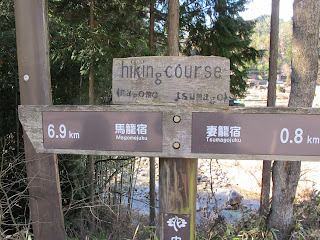
Tsumago to Magome Traditional Samurai Postal Route

Spectacular scenery but word of warning - leave your baby behind!!
Myself, my husband (Japanese), and my soon to be two year old daughter arrived at Nagiso station after a one hour train ride from Nagoya. The journey from Nagoya takes in just enough of rice fields and nature to get you in the mood for a bit of rural Japan.

Upon arrival, we were met by our hotel shuttle service, Kisoji Hotel, one of the biggest hotels in the area. With time to just drop our bags, we headed off again to start the Tsumago to Magome hike. We foolishly assumed this might be manageable with a baby-buggy and a tired and worn out child, but how wrong were we! I suppose what made me think it might be ok was the answer I got from the lady at the tourist desk at Nagiso station. I asked her in Japanese what she thought about us bringing a buggy along the trail. In typical Japanese style, she hymned and hawed and did not give a straight answer but kept smiling and saying it will be difficult but not impossible. The hotel porters again gasped when they heard we were bringing our child, who is not even walking one year now. So, from the start, I have to say I was quite apprehensive.

Anyway, off we went to Tsumago, the start of the old postal pathway along the Nakasendo road. Once used as the main access route between Edo (now Tokyo) and Kyoto this was where you would have met Japan’s samurai’s, geisha, merchant workers, old villages, and lots of hills, mountains, and magnificent nature. I was quite surprised at how well they have preserved this typically traditional area. I expected more commercialism (being Japan) but in fact, only a handful of the shops were open and only one soba noodle restaurant, run by two old ladies, was open where we could grab a bite before starting our walk. The wooden houses and shops appeared untouched since their former Meiji years, which was refreshing to see in a country where infrastructural planning doesn’t seem to exist. You will notice throughout Japan their lack of taste when it comes to buildings being plonked up anywhere, even if it hurts the eye. To be immersed in a village where we felt we had stepped back in time, having come from the city life, was other worldly in a way.

Concerned a little about time, we began our walk at 1pm. Bear in mind this usually takes people 3 hours with a normal load and the sun goes down before 5pm now in Japan (December). The sun was shining but it was still quite chilly. Ice remained on the shaded paths so bring your woollies if you plan to come in the Winter. It’s still possible to do and is crisp and refreshing but the temperatures can change quite dramatically so layers are recommended.

The paths started off a bit bumpy which we thought may be the worst we might find. But after about 2km through hills and gravel we came to a cobbled stair way that seemed to go up for quite a distance. So, instead of carting the buggy up, we decided to take the road instead, which was the right decision although we missed the scenery we ended up at the same exit from the forest. This happened a few times before Masaki finally said for me to go along the real route as there was no point in both of us missing the action inside the hills.
So off I went on my own. Brought my emergencies just in case as you never know what can happen outdoors in Japan. Not too long I came across a bell. Shocked at what was written on the piece of paper below it, I reluctantly rang it, as I was told to do. This was to keep the bears away. At first I thought it might be a joke but then I remembered how a few years back some bears were found on the platform of Matsumoto station, not that far from where we were. So, I hurried my steps to try to catch up with my family. Instead of keeping the bears away I actually thought by ringing the bell I would wake them up from their Winter sleep. So as you can imagine my heart was now racing (and so were my feet)!

After about 1km through the forest, with not a sinner in sight, I finally ended up on a road again. That was me done going through the forests on my own. As soon as I met Masaki, I took over pushing the buggy (severely uphill) for the next few km. Eventually I came to a bus stop that said a bus will arrive in 3 minutes. So, I called Masaki to tell him I was giving up and taking the bus. Luckily he was almost at the same spot so we both managed to get the bus as far as Magome. Although we only had a further 3km to go, the uphill push with the buggy took its toll. This, along with a child that didn’t stop crying almost for one hour, drove me to making this very weak decision. After boarding the bus though I must admit I was glad. There was a further 1km incline but the rest was a decline as far as Magome village.

Magome was slightly different to Tsumago. More shops, more food stalls – in a nut shell – more places to put our hands in your pockets to spend your yen! But it remains extremely quaint and traditional and definitely a highlight to the end of our adventure.

If I were to do it again I would chose from these two options:

1. Tsumago – Magome route

Spend more time in Tsumago enjoying the old buildings and museums. Walk for as much as possible, depending on our childs age and ability (children over 8 years old should be ok for the full walk, if they are used to walking. If not, then I expect they will tire quickly as there are quite a lot of ascends). When you find a bus stop (try to time the buses in advance as there are only a few that run throughout the day), make the right decision to wait or continue walking. There are quite a few bus stops along the way so you will be sure to get another one 15-20minutes later. This is what I did. Then, hop on the bus to Magome and enjoy your time here. You can wonder around both Magome and Tsumago for at least one hour each.

2. Magome – Tsumago route

The journey from Magome to Tsumago is definitely easier as most of the way is downhill (on the road anyway). So, if you have a buggy and really want to do the walk, do it the opposite way. Buses run to Magome from Nagiso station as well as Tsumago which are easy to get. Be sure to find out the times in advance as, again, there are not that many in one day. Because you are higher up in the mountains in Magome, the view is spectacular. Missing this at the end may be a slight disadvantage.  Tsumago feels like it should be the start for this reason but with a buggy, I wouldn’t care!

Hope this information helps the next family that decides to go. I highly recommend this trip for all ages. If you don’t want to do the walk at all that’s also possible. Most Japanese come in bus loads and stop at both villages by chartered coaches. So don’t feel bad. They are still really worth visiting and not that difficult to get to you on your own. I also recommend for the budget traveller to stay in the villages themselves. There are a few minshiku’s we can book for you. However, the huge benefit of staying at Kisoji is the amazing hot spring baths they have. You can chose between about 4 or 5 outdoor baths, an outdoor sauna, and a large indoor stone bath.

The buffet dinner is also very good (as far as buffets go in Japan) rather than kaiseki – if you are tired of eating traditional Japanese food. Selection of beef (roast/steak), smoked salmon, curry’s, pasta, salads, oysters, and more importantly – cakes and icecream! All you can eat!
Instagram

Wednesday, 22 August 2012

Fortresses of breathtaking beauty


Many people say that much of modern-day Japan exists because of its samurai roots. The samurai may no longer exist but a symbol of their power and strength does: castles.

Estimates vary in the number of castles still standing today in Japan. But almost every major city or area of the country has its own castle. Even with those castles that are “belittled” for being relatively recent reproductions, one must not forget that to re-create such structures is an incredible feat in itself, for which they are to be admired.

Many of Japan’s most striking castles were originally built during the “Sengoku Jidai (Warring States Period)” when the whole country was in chaos and fiefdoms needed to defend themselves. The ruler of Japan during the end of the 16th century, Toyotomi Hideyoshi, is widely regarded as a master castle designer. One of his greatest masterpieces is Osaka Castle, which known throughout the land as being impenetrable when it was first built. The reproduced version of this castle is a striking structure that has an observation deck 50 metres above ground, which offers a panoramic view of Osaka City and the mountains in the distance. Inside you can find many historical artifacts on display, including real swords.

But many castle aficionados will agree that one of Japan’s most beautiful castles has to be Kumamoto Castle in Kyushu, along with Matsumoto Castle and Himeji Castle. Designated a national treasure by the Japanese government, Kumamoto Castle still retains many of its original buildings. By far its most impressive feature is its exquisitely curved stone walls known as “musha gaeshi (warrior repelling)” that are some of the highest to be found in any castle in Japan. The castle grounds stretch for a few kilometres in any direction, show what a domineering presence it once was.

If you are interested in experiencing traditional Japan, no trip would be complete without a visit to a Japanese castle. Unique Japan Tours is happy to help arrange this for you. We look forward to hearing from you!!


Instagram